

Homestead: The Series' Charles Esten Talks Cain's Season 2 'Unraveling' And Brutal Episode 4 Choice
This post contains spoilers for Tuesday's episode of "Homestead: The Series." Please proceed accordingly.
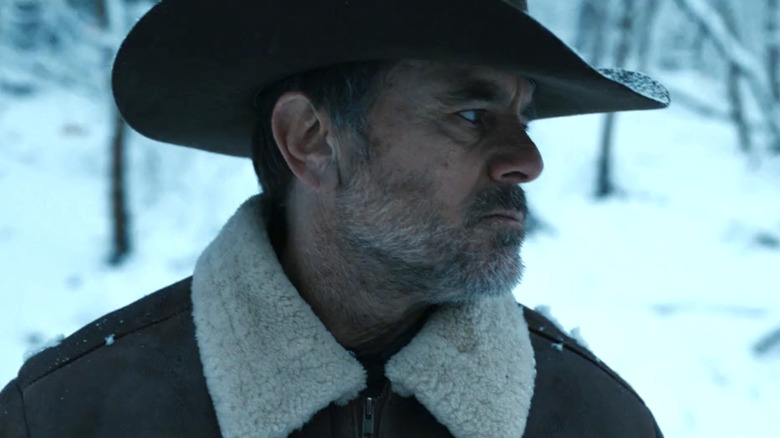
Right from the start of the post-apocalyptic drama "Homestead: The Series," now in its second season, Cain Ross has shown himself to be a decisive, divisive figure unafraid to take swift action.
Or, to put it in the terms of the Christian-influenced series: He's far more Old Testament than New.
This week's hour drives home that point: Cain, played by "Nashville" alum Charles Esten, banishes a hungry refugee to struggle in the wilderness after the hungry man tried to steal some soup for his brother. (First, though, Cain makes the poor man think he's going to kill him.) Then later, when Cain realizes that his sister-in-law Jenna (played by Dawn Oliveri) and niece Claire (Olivia Sanabia) are bringing precious homestead supplies to an orphanage full of refugee children and ailing mothers, he opens fire — on his own flesh and blood.
If this is your first visit to the compound, allow us to give you a quick tour of the place. The series, which drops new episodes Tuesdays on the Angel streaming service, is a sequel to the 2024 theatrical film "Homestead." That movie chronicled the breakdown of society after a nuclear blast on the West Coast of the United States. Ian Ross (played by Neal McDonough, "Tulsa King") and wife Jenna, well-to-do preppers with land and supplies in the Rocky Mountains, wrestled with whether/how to help those that came looking for help and shelter. When Ian became unable to lead and ultimately died in Season 1, Jenna asked his brother, Cain, to come and help her run the homestead.
This week's stark episode marks a good time to check in with Esten, whose TV career includes stints on shows like "Outer Banks," "Enlightened," "The Office" and many other series. He's also currently starring in the film "Drummer Boy," a musical set during the Revolutionary War. Read on as we chat about Cain's actions in this week's episode and what Esten points to as the start of his character's "unraveling" this season.
'Light and darkness in the most extraordinary situations'
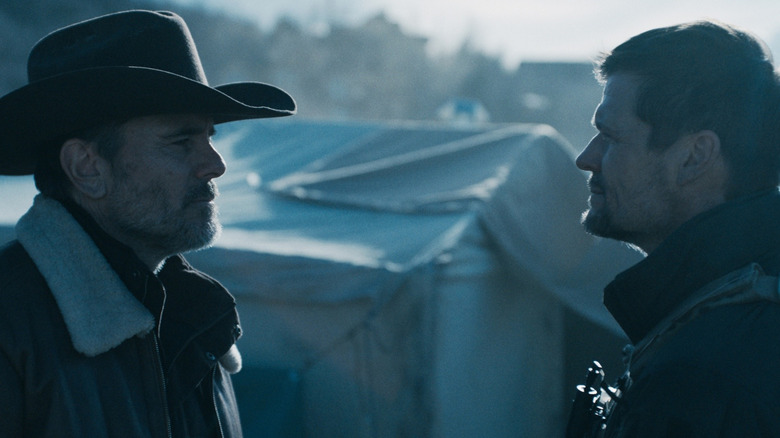
TVLINE | I don't think I've ever seen you smile less on camera than you do as Cain in "Homestead."
CHARLES ESTEN | It's interesting. I mean, on Nashville — where we first met and started talking — that guy went through it, but he was still wry. He didn't smile a ton in those early [episodes]. He didn't really smile 'til after Rayna said 'yes.' But Cain's a different thing. There's comedy in there. There's wry humor... But no, I can't deny that's the truth in that.
A lot of this show is about light and darkness in the most extraordinary situations, and darkness being the absence of light. Cain's darkness isn't a proactive thing. It's just that, for whatever reasons, he's been empty. And yet what I find so interesting about him is he's so drawn to it.
Jenna is the embodiment of that light and, and therefore the homestead is. So here's this dark guy trying to protect this thing that inside him has become his meaning, his raison d'etre: Don't mess with the light. But he'll do these dark things and to protect it — which, man, I mean, I get at a root level. [Laughs] It reminds me of, it reminds me of a little of [Jack] Nicholson in " A Few Good Men." Like, "You want somebody on that wall!" kind of a thing, right? You don't want the guy that's on the wall necessarily at your birthday party, but you want Nicholson on that wall.
Also, just as an actor... I use the smile in so many other roles, and the winning charm or whatever. It's interesting at this point in your career to go: "What if I don't use that tool as much?"
How Homestead: The Series' faith element 'heightens' the post-apocalyptic drama
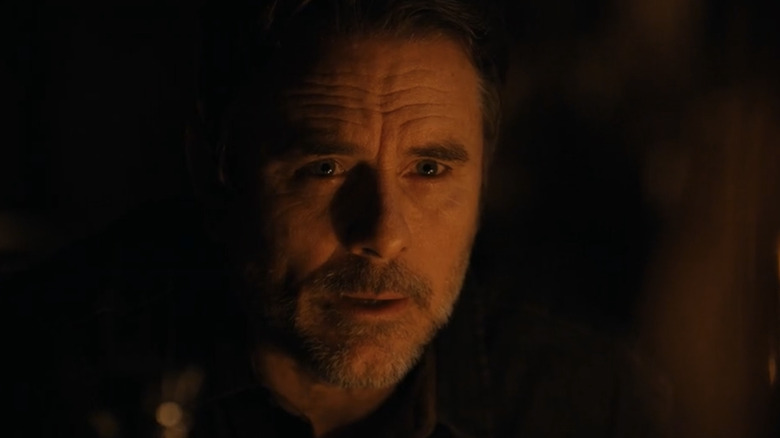
TVLINE | Let's talk about this week's episode. What's interesting to me is that Cain has good reasons for protecting the food supply and the homestead, but he loses perspective in that. He's shooting at his own sister-in-law and niece at the end. Talk to me about his being one of the only people in that situation who's willing to make hard decisions, and how he might be getting lost in that.
That's what drew me to "Homestead" in the first place, the concept of the post-apocalyptic thing. We've had [post-apocalyptic series], and there's zombies and there's all the other things we've seen after it. There's still tremendous humanity in a show like "The Walking Dead" and shows like that, but it's interesting to do it without all the zombies. They're all human beings.
Some of them are very dark, and some of them are very desperate. So it's one thing to build yourself a little compound, get all the stuff you'll need for a long, long time, and now let's see how long we can last. And then, the very first week, you notice a few people hanging around at your gate. And by the fourth week, there's 100 people out there, and you coached soccer with two of them, and your kid's best friend...
By the way, that's why I think it's great that the faith element heightens all of that. It's like, yes, you can survive. But will the person you want to be and the person that your faith is calling you to be survive? Or will you just survive as a shell of all that for no meaning?
And that's what's happening to Cain. There's that old expression of "There, but for the grace of God, go I." Well, there, but for the grace of God, goes Cain — because he's not asking for that, he has no time for any of that. We just gotta survive.
'You knew who you put on the wall'
TVLINE | That's an interesting way to look at it.
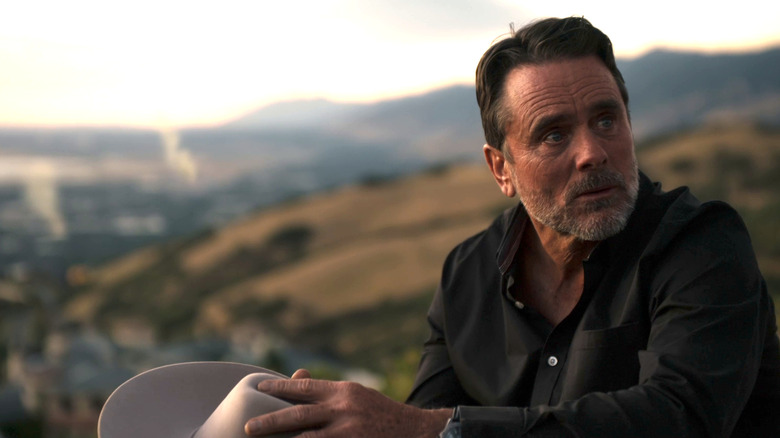
And in a real way, Jenna, it could be argued, in some ways uses it to keep her hands clean. He's even said that to her. She'd fight back on that. "I've never asked you to do that." Yeah, but you knew who you called, and you knew who you put on the wall.
But here's the problem: You don't get to dance with that darkness without it seeping into the other parts of your heart and your life and what you care about and what you don't. So everything gets very binary for Cain. Mark is stealing food? Bad guy. I can do anything to him.
Meanwhile, in [the Season 2 premiere], this little innocent girl who was the first bit of innocence that he's seen — and that's why I love those scenes so much — it's Cain talking to this person that he can't assign any agenda to or he can't other-ize. It's just a sweet little girl who knows her stuff about guns. [When he accidentally shoots her], that's what shakes him initially and unmoors him a little bit... Now he's doing the dark things without that certainty. He's unraveling in the face of the weight of all of that without something to give [him] the strength and the compass.