
By providing your information, you agree to our Terms of Use and our Privacy Policy. We use vendors that may also process your information to help provide our services. This site is protected by reCAPTCHA Enterprise and the Google Privacy Policy and Terms of Service apply.
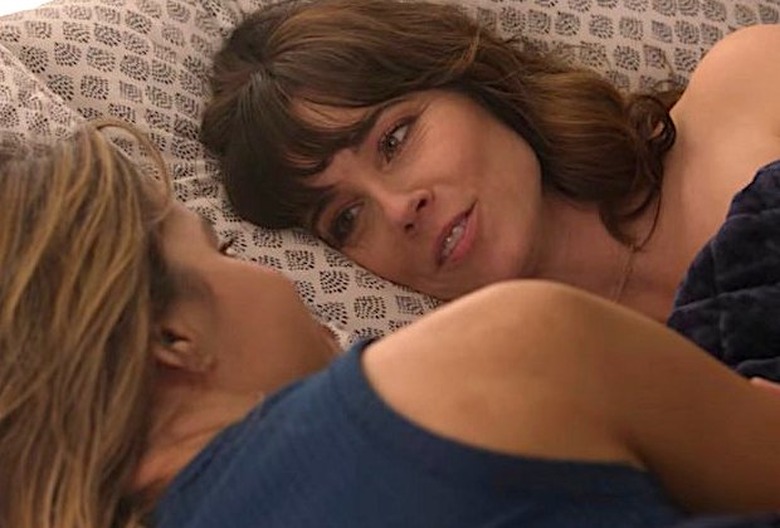
After spending much of Dead to Me‘s inaugural season infatuated with (and occasionally stalking) her ex-fiancé Steve, Linda Cardellini’s seemingly heterosexual Judy falls for a female chef (played by Natalie Morales) in Season 2 and no one — not even her blunt best frenemy Jen (Christina Applegate) — has an opinion about it. And that, according to series creator Liz Feldman, was the whole point.
“The [uneventful way we] played the [Judy/Michelle] relationship was incredibly deliberate and purposeful,” the EP explains to TVLine. “As a gay woman who has been writing a really long time, I’ve had the opportunity to tell the ‘coming out story.’ I wanted to see a different version of it. I wanted to see a no-big-deal version of it because, to me, it is no big deal. It felt fresh to me to treat a burgeoning relationship between two women like it was totally normal.
“On another TV show when a woman starts dating a man there wouldn’t be a conversation between her and her best friend where she sits her down and says, ‘Hey, listen, I gotta tell you something — I like guys,‘” Feldman continues. “I know some women who just ended up in a romance with another women and it wasn’t something they identified themselves as. It just is.”
Although Feldman acknowledges that having Dead to Me exist in a “post-label universe” is “probably a little idealistic,” she’s optimistic that as a society “we are getting there,” adding, “I just wanted to help us get there a little bit faster.”
I agree that a “post-label” world is idealistic. If anything, people seem to be looking for ever more labels to define the minutiae of their identities. Although, I will say that lacking any Bisexual identity, even within a character’s own represented psyche or show context, further reduces Bisexuality. Saying that it’s a non-identity is like nullifying it as a state of sexuality.
Agreed. Funny how whenever a character is gay, even if there’s no big coming out story, it’s confirmed that they’re gay, but when a character is shown being attracted to multiple genders, they’re always fluid / don’t need to be defined / so woke they don’t need labels, and like… that’s great, but why have we skipped straight passed Bisexuality? Can’t we get a fair amount of bi rep first before just deciding that any character that likes more than one gender is just too cool for labels? It’s happened quite a few times now. Like writers/creators think the word is dirty and they don’t want their characters associated with it. Some people love the idea of a world without labels and I see why, but it’s also not wrong to have them, and the bi erasure… it’s just too much.
Yeah, you would never hear a gay character say they don’t believe in labels any more that you would a straight character. (Admittedly, most straight people don’t really even consider the idea of labels much, simply by virtue of being part of the mass majority.) Fighting for respect and representation despite your identity is a considerable amount of what the gay community fights for. But Bisexuality exists along a wide spectrum of gray and those at the opposing poles never know what to do with it. As a rule, people struggle with gray areas. Anything that doesn’t fit into a black and white narrative must be explained away somehow. So creating a non-labeled identity removes any need to consider that identity. (Even though I think vastly more people live along that spectrum than they’ll ever openly admit. A person who is 98 percent one way and 2 percent the other, still fits the description.) And the idea that nobody in your life would even bat an eye if they found out you were more fluid than previously understood, is ridiculous. As most of humanity exists as heterosexual, (by virtue of biological necessity), our involuntary natural assumption is for likeness in those around us. It’s not good or bad. It just is. There will never be a time when it isn’t so. It doesn’t have to be a negative response, but there will be some kind of response. And anyone assuming that about me, isn’t offending me, even though I live somewhere along that spectrum. Avoiding the discussion doesn’t make a person’s identity cease to exist. Even though I have no use for the overly precious, look-at-me, label smorgasbord that inundates the discussion these days, (the thing that I am is me and nobody else), I do think that Bisexual (or Pansexual if you’re particularly egalitarian) is a perfectly good, blanket word for anyone not under the rigidly specific tents at each end of the spectrum. But it’s not the dirty word it gets treated as.
I legit didn’t even bat an eye. Never thought, “well, wait a minute. Isn’t she straight? She was ‘obsessed’ with Steve last season and now she’s dating this woman?”
I loved Judy’s storyline with Michelle in season 2. I found it perfectly believable that her character could be bisexual, and I loved that Jen never questioned it or made a bigger deal out of it than it needed to be, which probably would have happened on any other show. Also I really hope Natalie Morales returns for season 3 because that relationship needs some closure (or, hopefully, continuation!)
Agree on everything you said. It’s just another layer to the character and I loved it.
Yes me too!
I looked at Judy as a free spirit who loves who she loves no matter the sex. Season 2 was great! Bring on season 3!
Well, at the risk of not being politically correct and I’m very progressive, do we really need a gay-lesbian angle in just about every series or a majority of them on cable or streaming services? I found it out of character and just a gimmick to attract buzz.
Exactly!
Yes, the gimmick to attract buzz that nobody involved in the show talks about unless asked. Go home, Karen.
Can I ask why you’ve framed characters being LGBTQ as an “angle” and a “gimmick”? Why is it that when minorities that exist in real life are shown on screen, there are always people questioning the necessity of their existence?
Agreed Hannah! Minorities are represented in movies and series because they are there. They are there in real life. Somehow comments like ‘I don’t have any problems with gay people, I just don’t want to see it on my tv’ just make me cringe. It’s so obvious they’re not okay with it.
Thank you, Hannah. No one ever questions when heterosexual relationships happen. But if it’s an LGBTQ or an interracial relationship, suddenly it’s “gimmicky” or “being shoehorned in”. Y’all know that it’s not just white heterosexual people watching these shows right? It’s always nice when everyone can be represented and not just white cis couples.
Spot on.
I wonder if those commenting about the “need” for such characters will eventually realise how redundant their questions are. I wish them the best.
Yes, this! Having diversity in your world isn’t a gimmick – it’s a step toward getting closer to real life (especially in CA!)
agreed, to me its the equivilant of saying “do we need another african american on the show?” or “why are there so many people of color, to be politically correct?: Black, white, gay, straight, we all make up the fabric of society, so why wouldn’t it be represented? So frustrating to hear people saying stuff like “had to be shoehorned in”.
To me it wasn’t a shock to see Judy attracted to a woman, she just seems like one to love and fall in love easily. I was more surprised that Jen had nothing to say about it, but also surprised how she quickly internalized what was happening and reacted as if it was no biggie and not a shock. It was welldone
That makes about as much sense as saying “do we really need the white person angle” on every single show?
Just because a person doesn’t look or love like you didn’t make it an “angle.”
I love the way that they handled it! It’s no big deal at all when someone is gay; it’s so odd that there are still people who don’t like gay people.
Also odd that some people that say that they don’t have a problem with gay people, do have a problem seeing them on tv.
The percentage of gay people, in real life, is probably less than 10%. The percentage of gay characters on cable/streaming services is far higher than that. Therein lies the problem. Hollywood keeps cramming into peoples conscience in, what I believe, is an attempt to better legitimize it. That turns a lot of people against the LGBT movement. Now, I am not saying I’m in that camp, just pointing out what frustrates a lot of people.
It’s actually only 4.5% of the total population.
you’re talking numbers from the 2016 consensus. Lets get this straight:
-from 2012 to 2016 there was a reported 1.75% uptick in people reporting that they are LGBT
-2020 consensus has not been released yet, but a bigger spike is expected
-this is just people REPORTING that they are LGBT. This does not account for the people who havent come out yet, or told their friends and not their family.
That 4.5% that you’re talking about is actually way higher
yeah, i don’t buy that. On Dead to Me theres 30 characters that were in 2 episodes or more. Out of all of them, 4 were LGBT (Judy, the Detective, Michelle, Jeff), which is 13% LGBT (instead of 10%). Not exactly tipping the scales. Seems pretty real to me, especially where they live. I don’t think having 13% as opposed to 10% should be a frustrating thing
I just figured that she had always been bisexual and that was something that viewers were learning about her. The premise of the show started with the Jen’s husband being killed in a hit and run and as it went on, we’ve learned more about the characters so I just saw it as something new that we were learning about Judy.
“I like the wine, not the label” to quote another likable tv show.
Pushing their lefty lifestyle on everyone else. Less than 5% of the population yet they’d like us to believe they are the majority. Nope. They’re going to ruin this one now.