

The Pitt's Taylor Dearden Goes Deep On Mel's Identity Crisis, Langdon And Robby, New Friend Santos, And More Ahead Of Season 3
Pittsburgh Trauma Medical Center resident Dr. Mel King had a terrible, horrible, no good, very bad day during Season 2 of HBO Max's "The Pitt."
As if internalizing her imminent deposition wasn't burdensome enough, Mel also went through something of an identity crisis, sparked by a question she'd never really had the luxury to consider: Who is she when she's not taking care of someone else? Moments later, she was shoved to the ground by the very patient who'd been flirting with her, now attempting to evade the cops.
But the biggest emotional blow came when Mel discovered that her sister Becca, for whom she serves as caretaker, had an entire life she knew nothing about — including a boyfriend of six months with whom she'd become sexually active. The revelation left Mel ruminating on her own life and confronting her greatest fear: winding up alone.
That gave Taylor Dearden — who TVLine named Performer of the Week for Season 2, Episode 2 — a lot to play with during her second shift, ultimately resulting in her first Emmy nomination for Outstanding Supporting Actress in a Drama Series. She's joined in the category by fellow first-time nominees Fiona Dourif (Dr. Cassie McKay) and Sepideh Moafi (Dr. Baran Al-Hashimi), as well as reigning champ Katherine LaNasa (charge nurse Dana Evans).
With the final round of Emmy voting now underway, TVLine is sharing its recent conversation with Dearden (embedded above and transcribed below), who reflected on her Season 2 storyline — namely, Mel's relationships with Drs. Michael "Robby" Robinavitch (Noah Wyle), Frank Langdon (Patrick Ball), "primal scream therapy" partner Trinity Santos (Isa Briones), and sister Becca (Tal Anderson) — and looked ahead to Season 3 (premiering January 2027).
Who Is Mel Without Becca?
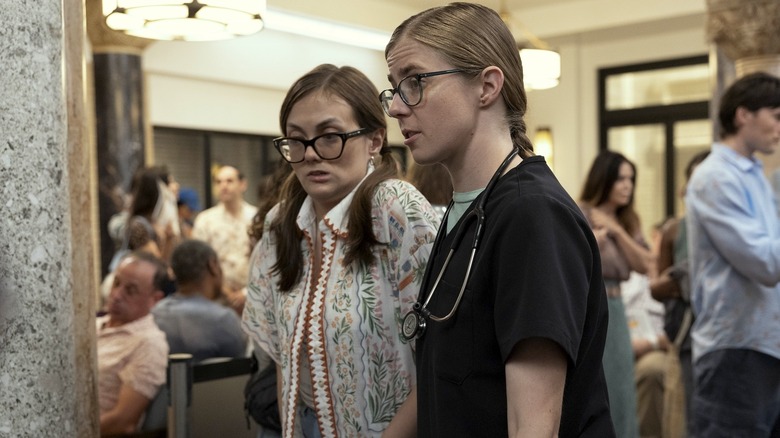
TVLINE | We talked earlier this season about how caring for Becca isn't just something Mel does — it's who she is. It gives her purpose, structure, and a sense of control. As that foundation begins to erode over the course of the season, how did you approach playing someone who is suddenly forced to figure out who they are without the identity they've always relied on?
DEARDEN | Mel finds herself on such shaky ground, not knowing exactly how to proceed or what is right for her. And it was really "actor fun" to just kind of feel like the rug was pulled from underneath her. She just has — as you said — no real foundation anymore. Part of that is just allowing yourself to be lost.... And so it's a really fun thing to, in a way, flounder for a bit.
TVLINE | That scene in Episode 11 where Mel unloads on Becca is so emotionally raw. How much of what she's saying do you think is really about Becca, versus Becca simply being the person who's there as Mel's entire sense of self is unraveling?
DEARDEN | I think it kind of dawns on Mel, too, that Becca has never seen herself as being in the care of Mel. And so Mel's whole identity of caring for Becca has never been reciprocated. It's just panic. And it just so happens to come out on Becca, but I think she would have panicked the same way if Becca wasn't actually there, and they hung up the phone and she had to deal with all of this on her own. I definitely think it was more of her panicking and trying to figure out what this means for next steps — of just how to be a person in general, rather than actually being angry at Becca or anything like that.
TVLINE | You have a wonderful scene with Katherine LaNasa in the stairwell — also in Episode 11 — and one line that really stood out to me is when Mel calls Becca a "f–king liar." Dana immediately reacts because it feels so out of character. I have to imagine that stood out to you the first time you read the script. What did that reveal to you about where Mel is emotionally — something that maybe hadn't fully surfaced yet in her confrontation with Becca?
DEARDEN | I think there's a different kind of pain when someone doesn't need you anymore. But there's a whole brand new wave of hurt when someone doesn't want you anymore, and I think Mel is feeling like Becca doesn't want or need her anymore. It's just sheer panic, and trying to process emotions quickly — which is not going to be a strong suit of Mel's — and trying to figure out what this means for the rest of her life. Because I think Mel thinks big as opposed to just, "Get through the day." It's like, "No, no, it's everything right now." And it's big. And I think cursing is just really showing how big it is to Mel. And life-changing. She has to rearrange everything now, and I think that's all weirdly indicative from saying the F-word.
TVLINE | At this point in the season, what do you think weighs more heavily on Mel: losing the role she's always had in Becca's life, or confronting the possibility of being alone?
DEARDEN | Oh, it's definitely being alone. I think Mel saw herself as a caregiver — less out of need of caregiving, and more out of, "Oh, here's an assignment. This could be my life." And so I think the idea that she's not needed or wanted anymore is a devastating thing.
Mel has seen herself as this person who has, truthfully, self-sacrificed to a crazy degree... and just knowing that the one person you thought would always be there now has other, better things to do, I think it's a new level of panic of being alone.
Mel was always kind of alone, but she had that one person. It felt like most people around her didn't understand her reaction. And even though they might be sympathetic, they don't really understand the implications that she's feeling, and that it's like an all-or-nothing here, and the answer is nothing now.
A Father Figure... A Brother... A Friend
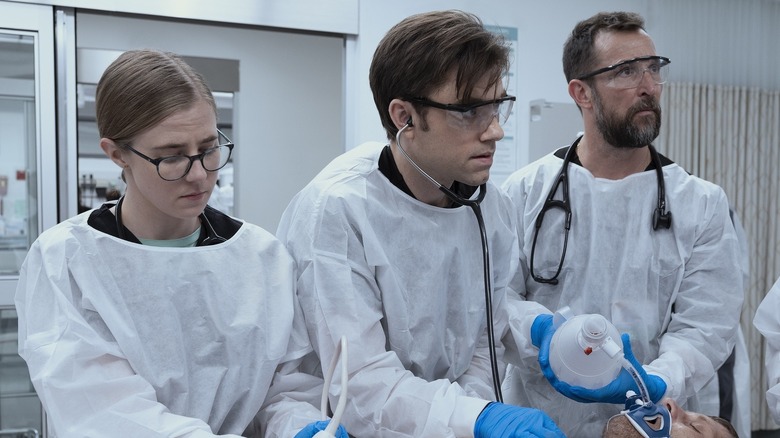
TVLINE | We've talked before about Mel losing her parents, which isn't something the show dwells on, but it's something I found myself thinking about this season. I get the sense she's been fortunate to have strong female role models in her life — working under Dr. Al-Hashimi at the VA being one example — but having lost her father, I found myself wondering what kinds of male mentors she's had in her life. Did that factor into how you thought about Mel's relationships with Robby and, especially, Langdon, and why Langdon's friendship and mentorship seem to mean so much to her?
DEARDEN | I would say with Robby, yes, but not with Langdon. I think Langdon has filled a new and different box in her life of [being] kind of a brother. And it's not the dad relationship you're looking for, but it feels more equal. Something I know Patrick and I both loved to show in the second season is going from more mentor-mentee [to] more equals, where they're both very protective of each other. And they both kind of get each other.
I think for Langdon, Mel is someone who will not judge as a fault. She cannot judge someone, really. Coming back from rehab, there's still someone who completely believes he's good now. I think everyone else is kind of like, "It's only a matter of time before he relapses," and Mel's like, "No, I believe you. You're done."
And I think for Mel to have someone who tried to get to know her is everything. We loved playing that scene at the end, where it just doesn't seem to have the same unevenness that it did in the first season, or even the start of the second season. It was just kind of like pals hanging out, talking about their day. And it was simple, and I thought the simplicity of that was also beautiful.
But for the first season, Mel stuck to Robby like glue. Even in his curmudgeonly Robby way, he still did take an interest in Mel more than normal. A lot of characters [during the] first season were like, "I don't know what to do with you, so I'm just gonna, like, not be here." And he found himself not speaking her language exactly, but he was hyper-encouraging of Mel.
Actually, in both seasons, as much as Robby was in trouble in the second season, he still found times to reassure Mel. And so I think there's something he gets about her, but he doesn't really know how to word it either. And I think she definitely sees the father figure in Robby.
TVLINE | Isa and I previously spoke about Mel and Santos' karaoke excursion at the end of the season, and she described it as "primal scream therapy." Do you think Mel experiences it the same way, or is something else going on for her in that moment?
DEARDEN | Normally, no. But I think that night was also primal scream therapy for Mel. I mean, they're both — no one's as tired as Santos [in the] second season — but to find whatever random energy bubble you have left in you and just go out after a long, tough day, and just — what do they call them? Screlting? Scream-belting? Just screlt. Screlt like crazy.
For Mel, it means so much to be asked in general, and to be trusted, too.... I think [the screlting represented] so much of her day, and so much of what she wanted to probably yell at Becca about.
It's the first time you see Mel physically, metaphorically, and literally take her hair down. So it's just like, "Oh, the structured person is letting loose a little bit." And I think it's much more of Mel trying on what it's like to be a little looser than something that comes naturally for her, which is why it's just a little awkward for sure.
TVLINE | Isa also mentioned that the two of you came up with the idea of Santos letting Mel's hair down because it's not something Mel would think to do herself. What do you think that moment signifies for Mel?
DEARDEN | I think the reason I have the braid and will continue to have the braid for my character at work is because it's structure. It's perfect structure. I'm the only one whose hair does not get in the way, because it's perfectly put into a braid that goes down my back, and it keeps me exactly in the moment. I don't have to worry about anything.
It's not a very attractive braid. It's plastered down because it's the most efficient and routine, and so I think that moment was the most, like, "Mel is trying something." I don't think Mel enjoys being touched without permission, but she kind of lets her do it. I thought there was something there that was especially fun where it's kind of like, "Yeah, Mel might need someone to help her get out of her box," and to have someone just safely pushing her towards that was, I think, really invigorating.
Emmy Recognition... and What's Ahead in Season 3

TVLINE | Several of your co-stars are Emmy nominees this year — and you and Tal Anderson, who plays Becca, are both first-time nominees. Considering how central your scenes together were to Mel's journey this season, what does it mean to get to share that milestone with her?
DEARDEN | It's great. I haven't seen her yet, but it's so cool.
I think, too, for two neurodivergent characters and neurodivergent actors, it feels extra special in a way. We know how much harder it is for us to do normal daily things that no one else has to think of, and it does feel like an extra big pat on the back of, like, it's so hard. Everything is harder, and it's like this is — I don't know, it just feels very much next level, and I'm so happy to be sharing it with her.
TVLINE | As we speak, you're about four weeks into production on Season 3. We know very little beyond the fact that it picks up in mid-November. I know you can't say much, but can you give me a sense of where Mel's head is at compared to where we left her at the end of Season 2?
DEARDEN | I can say that Mel has a new stress in her life. It's some of the frustration that exploded out of Mel in Season 2... but I think there's a lot more of that in Season 3 — trying to find her place, and trying to do this whole friendship/independence thing. She's not going to do super well right away, but she's going to try her hardest at reaching out, seeing if anyone needs [her] help.